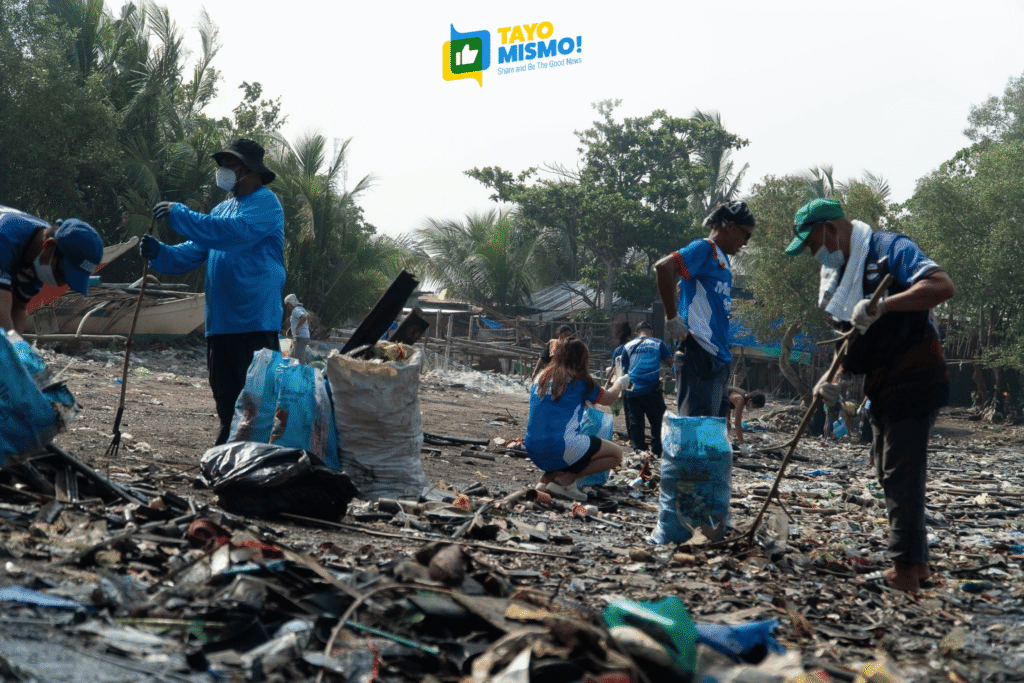

Not every cleanup on September 19 happened at a mall or under a government banner. Across the Philippines, smaller volunteer groups, island communities, and schools organized their own versions of the International Coastal Cleanup (ICC) despite far fewer resources, but with no less commitment.
Off the coast of Negros Oriental, the cleanup at Apo Island brought together staff from the island’s protected landscape and seascape office, the local youth council, the Apo Island Women’s Association, and the island’s snorkeling guides’ association, alongside the Tourist Police Unit and the Philippine Coast Guard. For a community that depends on its reef for both tourism and daily income, the cleanup doubled as a reminder that its economy and its ecosystem are, in practice, the same thing.


Meanwhile, at Baseco Beach in Manila—DENR’s flagship site for this year’s cleanup—the activity ran alongside an “Upcycle & Circularity Expo,” where social enterprises and small businesses turned materials that would’ve ended up as trash into things people could actually buy.
Down in Zamboanga del Norte, coastal cleanups in various areas folded into a larger, EU-funded climate program run by XAES Foundation and ChildFund Philippines. Children, youth, and parents joined community volunteers on the shoreline, using a waste-tracking app to log what they collected. This turned a single day’s cleanup into data that could help communities understand what’s actually washing up on their coast.
Further west in Puerto Princesa, Palawan, the Rotary Club, its youth wing Rotaract, and barangay officials in Macaracas paired their cleanup with something more permanent: mangrove planting, meant to protect the coastline from erosion and give marine habitats a place to recover.

Schools across the country also carved out their own spaces in the movement. At Don Bosco School Manila, student officers and educators spent the day at Manila Bay’s Dolomite Beach, framing the cleanup as part of the Catholic Church’s Season of Creation and collecting over 22,000 pieces of trash.
Along the shores of Cabangan, Zambales, the Alon and Araw Club marked the day alongside San Isidro Integrated School, pairing the cleanup with a short talk on why the trash matters in the first place. It’s a smaller version of what the group does year-round: trade free surf lessons for local kids in exchange for showing up to beach cleanups, so that caring for the ocean comes with a reward attached.

Filipinos throw away an estimated 60 billion plastic sachets a year, and by most academic accounts, only a fraction of the country’s barangays have a material recovery facility that actually functions as intended under the law. A day of cleanup, however well-organized, doesn’t undo that math.
What these smaller efforts do show is that you don’t need a government mandate or a corporate partner to make a difference.
You don’t need a barangay office, a school club, or an organization behind you to start one. Pick up a trash bag and find a stretch of shoreline nearby that you and your friends can help clean.