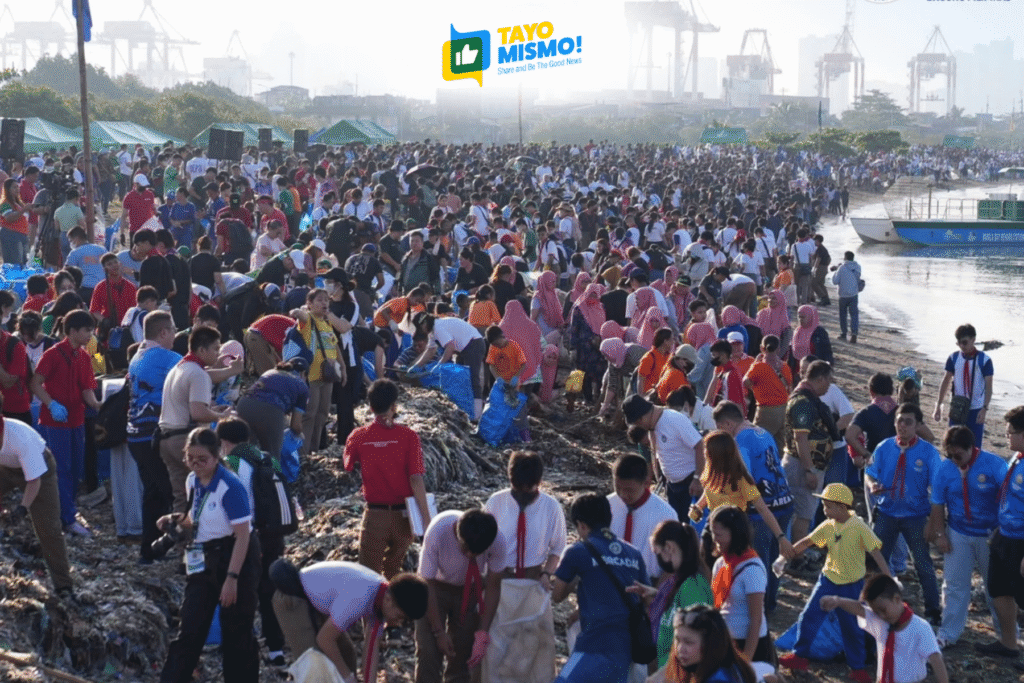

More than 103,000 volunteers across all regions of the Philippines spent their Saturday clearing trash from the country’s coastlines, rivers, and waterways this September as part of a nationwide cleanup that recovered over 466,000 kilograms of waste from 369 sites.
The Department of Environment and Natural Resources (DENR) led the effort as part of this year’s International Coastal Cleanup (ICC), observed every third Saturday of September.

The initiative brought together national government agencies, local government units, schools, businesses, civic groups, and community organizations, all working under this year’s theme, “Clean Seas for Resilient Communities.”
Beyond clearing visible trash, the cleanup was also used for gathering data on the types and volume of waste reaching coastal areas. This helps inform efforts to reduce plastic pollution and improve waste management nationwide.

In the Ilocos Region, DENR’s regional office mobilized 2,613 volunteers to clear roughly 30 kilometers of coastline across Ilocos Norte, Ilocos Sur, La Union, and Pangasinan, collecting a combined 4,896.13 kilograms of waste.
In Santa Maria, Ilocos Sur, over 300 volunteers cleaned more than two kilometers of coastline across four barangays that form part of a critical habitat for marine turtles, clearing over 600 kilograms of litter that could otherwise threaten the very turtles the habitat was created to protect.


Some DENR field offices coordinated cleanups across several provinces at once, from Camarines Sur and Camarines Norte to Albay, Masbate, Catanduanes, and Sorsogon, drawing nearly 6,800 volunteers and collecting close to 8,900 kilograms of waste combined.


Farther south, Davao Region’s cleanup drew nearly 6,900 participants from government agencies, schools, and community groups, clearing roughly 32 kilometers of coastline and collecting over 19,000 kilograms of waste.
A number of these cleanups also involved private sector partners, from telecom and logistics companies to local malls, working alongside local government units and barangay volunteers.
The annual ICC also promotes proper waste segregation and disposal, encouraging communities to take part in protecting the country’s coastal and marine resources.

Organizers have noted that most of the waste collected during the cleanup didn’t originate at the coast, emphasizing that protecting the ocean starts with how waste is managed on land. Community-led cleanups like this year’s ICC remain one of the more direct ways for the public to take part, alongside continued efforts to reduce waste before it reaches the sea.
You don’t need to wait for next year’s ICC to pitch in—segregate your waste, cut back on single-use plastic, or join a cleanup happening closer to home.